2 February 2022
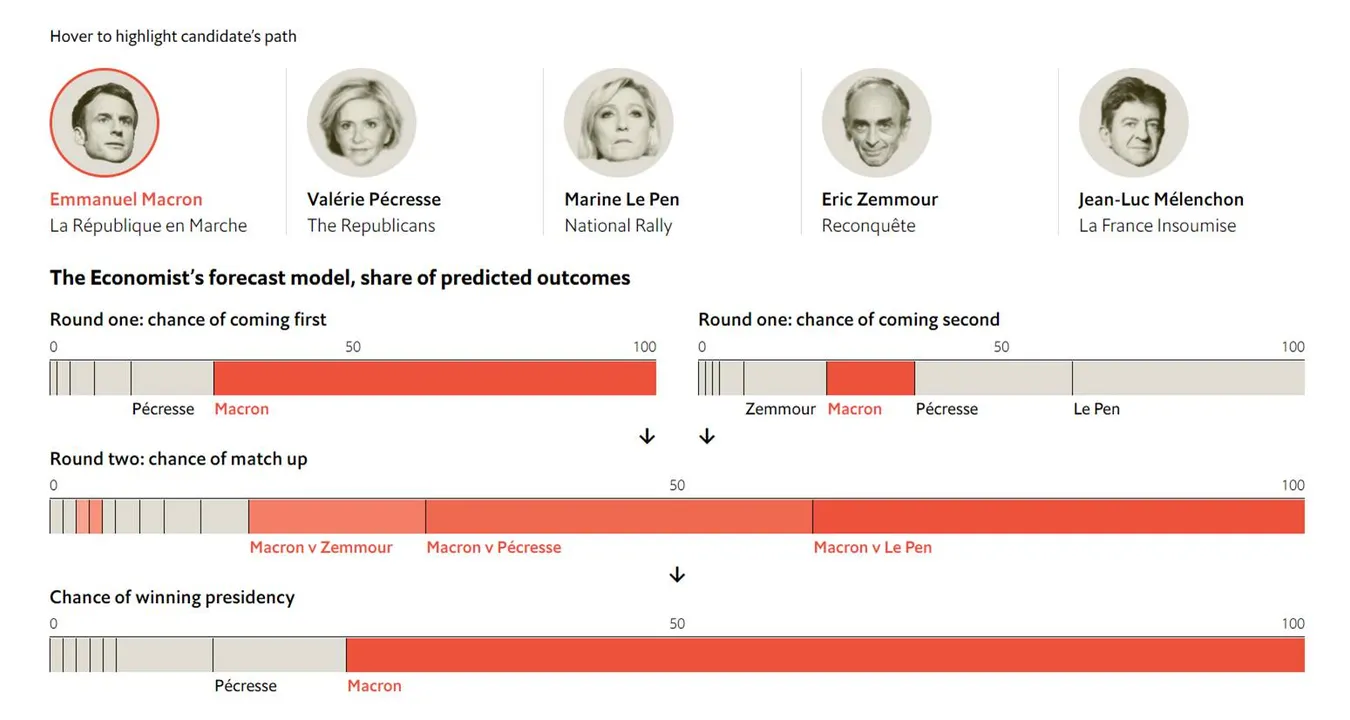
The Economist’s French presidential election model forecasts a 79% chance of victory for Emmanuel Macron; potentially serious challenge from Valérie Pécresse
Read more


Business Finance, Government, Business Finance, Government
The Economist backs the campaign for Britain to remain in the European Union
The Economist today announced that it will endorse the campaign for Britain to remain a member of the European Union. If Britain leaves, it is likely to end up poorer and less innovative. Politically, it will be become less influential and more parochial. But if it stays, it can continue to shape the EU, even over the vexed subject of immigration.
Vote Leave says that quitting the leaden, undemocratic EU would cut Britain free to reclaim its sovereign destiny as an outward-looking power. By cutting red tape, British business could thrive. By controlling who enters the country, it can pick the people with the most to offer.
In fact, confronted with the reality of Brexit, Vote Leave’s plans would fall apart:
On the economy: Vote Leave’s promise to open markets and enhance prosperity is a reckless gamble. Almost half of Britain’s exports go to Europe. Access to the single market is vital for the City and to attract foreign direct investment. Yet to maintain that access, Britain will have to observe EU regulations, contribute to the budget and accept the free movement of people—the very things that getting out is supposed to avoid.
On liberal reform: Vote Leave says that it wants to cut Brussels’ red tape. But, to have a chance of victory, its free-market leaders have struck an alliance with a less vocal crowd of Leave voters who mistrust globalisation. Britain’s obstacles to growth—restrictive planning, a tortuous tax system and weak education—are home-grown. In six years of government, the Tories have failed to dismantle them. Leaving the EU would not make it any easier.
On Europe: Vote Leave says that the EU is run by unaccountable bureaucrats who trample on Britain’s sovereignty as they plot a European superstate. In reality, Brussels is dominated by governments who guard their power jealously. The task of making them more accountable is an argument about democracy, not sovereignty. Instead of leaving, Britain should stay and work for reform.
Even if Britain can leave the EU it cannot leave Europe. The lesson from history is that, because Britain is affected by what happens in Europe, it needs influence there. If Germany is too powerful, Britain should work with France to counterbalance it. If the EU is failing, it has an interest in seeing the pieces land in the right place.
A vote to quit the European Union would do grave and lasting harm to the politics and economy of Britain. The loss of one of the EU’s biggest members would gouge a deep wound in the rest of Europe. And, with Donald Trump fuelling economic nationalism and xenophobia, it would mark a defeat for the liberal order that has underpinned the West’s prosperity.
Over the years The Economist has found much to criticise in the EU. But those who would leave offer no coherent alternative except a series of implausible and inconsistent assertions. The Economist believes that leaving would be a terrible error. It would weaken Europe and it would impoverish and diminish Britain. Its vote is to remain.
The full leader is available here: http://bit.ly/1UQcE0b
Our 18-page compilation of “Brexit Briefs” analysing Britain’s EU referendum is here: http://econ.st/24QxOhy
-ENDS-
Media enquiries
For details on this press release or to interview one of our journalists covering the Brexit debate, please contact hollydonahue@economist.com
About The Economist (www.economist.com) With a growing global circulation and a reputation for insightful analysis and perspective on every aspect of world events, The Economist is one of the most widely recognised and well-read current affairs publications. The paper covers politics, business, science and technology, and books and arts, concluding each week with the obituary. In addition to the web-only content such as blogs, debates and audio/video programmes available on the website, The Economist is available to download for reading on Android, Blackberry PlayBook, iPhone or iPad devices. The Economist Espresso, our daily briefing smartphone app, is also available for download via iTunes App Store or Google Play.
2 February 2022
2 February 2022

17 November 2021
12 November 2021