2 February 2022
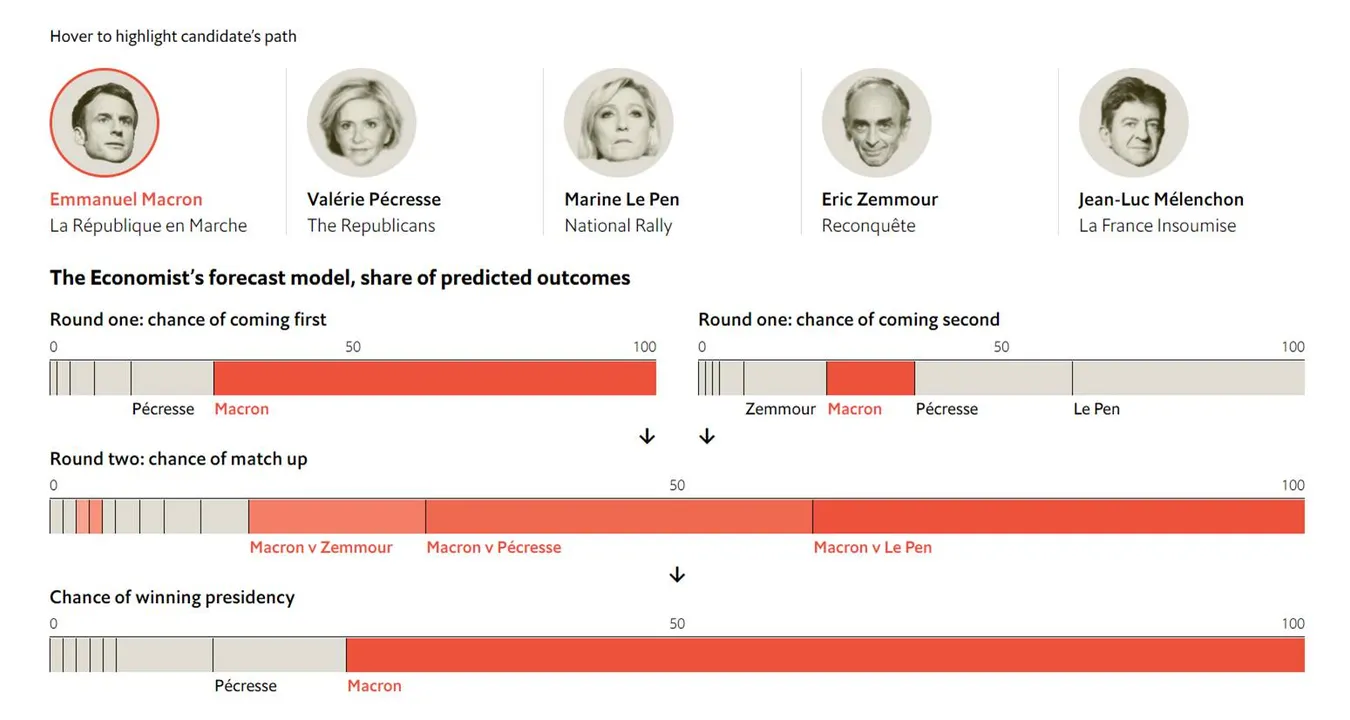
The Economist’s French presidential election model forecasts a 79% chance of victory for Emmanuel Macron; potentially serious challenge from Valérie Pécresse
Read more

Business Finance, Technology, Sustainability, Editorial, Business Finance, Technology, Sustainability
The Economist has today released “If the ocean was transparent: The see-through sea”, a journey through the ocean as it has never been experienced before: imagining that its floor was truly visible as if through air. Today’s reality is different: almost the whole ocean floor is dark to those that inhabit it, and invisible to those beyond. Because of the ocean’s opacity, the surface of Mars is better mapped than that of the Earth.
But this is changing. Over past decades techniques such as multibeam sonar and radar-altimetry have produced a new picture of the ocean’s contents and its floor. In future, the spread of marine drones, coupled with new data-processing techniques, may make it easier to spot things (including submarines) that could previously remain hidden in the ocean. Such technologies have thus the potential not only to reveal the secrets of a submerged world, but also to affect the military strategy of the leading global powers.
A truly transparent sea would reveal the ocean floor to look rather different to the way it is commonly portrayed. Maps typically render it in a “shaded relief” style, with added “false colour”, and for this to make sense to the untutored eye the relief has to be exaggerated, typically by a factor of 10 or 20. So people have become used to thinking of the ocean floor as interestingly craggy. It really isn’t. In fact, “seamounts” (ocean-floor protuberances that do not make it to the surface) typically rise gently: “A seamount that could not be walked up by a fit septuagenarian is a rarity,” as The Economist puts it.
So far, altimetry has discovered more than 10,000 seamounts. If the ocean was transparent, statistics suggest that hundreds of thousands of smaller ones would be visible. Added together, that’s an ecologically interesting habitat about the size of Europe previously almost completely uncharted.
The Economist concludes: “There is a fear that making things visible will strip them of their mystery. Perhaps, in some ways, it does. But it need not strip away curiosity or wonder.”
“If the ocean was transparent: The see-through sea” is available now at worldif.economist.com. It is part of The Economist’s annual collection of hypothetical scenarios, The World If, which will be published as a supplement in the print edition of July 2nd, as well as online and in apps.
-ENDS-
Media notes
For details on this press release or to arrange an interview with Executive Editor of The Economist and Editor of The World If..., Daniel Franklin, please contact hollydonahue@economist.com
About The Economist (www.economist.com) With a growing global circulation and a reputation for insightful analysis and perspective on every aspect of world events, The Economist is one of the most widely recognised and well-read current affairs publications. The paper covers politics, business, science and technology, and books and arts, concluding each week with the obituary. In addition to the web-only content such as blogs, debates and audio/video programmes available on the website, The Economist is available to download for reading on Android, Blackberry PlayBook, iPhone or iPad devices. The Economist Espresso, our daily briefing smartphone app, is also available for download via iTunes App Store or Google Play.
2 February 2022

2 February 2022
17 November 2021

12 November 2021