2 February 2022
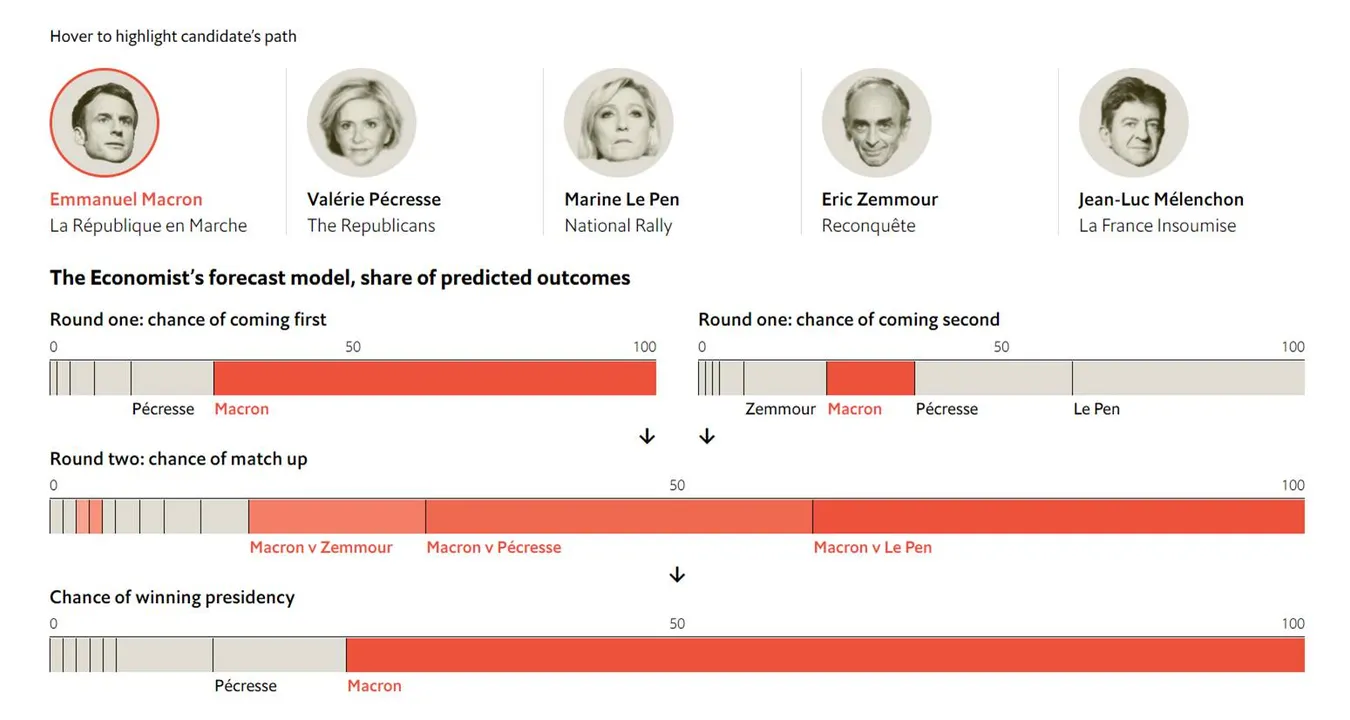
The Economist’s French presidential election model forecasts a 79% chance of victory for Emmanuel Macron; potentially serious challenge from Valérie Pécresse
Read more


Business Finance, Consumer, Entertainment, Fashion, Government, Health, Lifestyle, Luxury, Music, Non Profit, Sport, Technology, Transport, Travel, Racing, Sustainability, Editorial
(LONDON)--June 19th 2019--Building on the success of its 2018 essay contest, which garnered more than 1,500 entrants from over 60 countries, The Economist again invites young writers to enter its second annual Open Future essay competition. Open Future is an editorial initiative to remake the case for the newspaper’s founding principles of political, economic and social freedoms at a time when these values are under assault.
“Last year’s essay competition exceeded our expectations in terms of the quantity and quality of the entries. We hope this year’s theme, on climate change, similarly energises young people to think critically and argue persuasively,” said Zanny Minton Beddoes, the editor-in-chief of The Economist.
“Open Future is a forum for big ideas on urgent issues. The essay competition is a way to spur new thinking and to build a community of people militating for practical, effective change,” said Kenneth Cukier, a senior editor leading Open Future.
The contest is open to anyone aged 16 to 25. The deadline for submissions is July 31st 2019. Essays must be no longer than 1,000 words. They should take a stance and make a case based on argument and facts. Though good writing is important, judges will make allowances for those for whom English is not their native language.
The essay question this year is:
What fundamental economic and political change, if any, is needed for an effective response to climate change?
Description: For decades the world has been aware that human activity is heating up the planet to dangerous levels, with potentially calamitous consequences. Despite efforts by government, business and individuals to curtail the trend, carbon emissions are still rising. Perhaps new thinking is needed, since previous attempts to deal with the problem have failed. So what might be done?
The winner will have their essay published on The Economist’s Open Future site and will be invited to attend the Open Future Festival on October 5th in either Hong Kong, Manchester or Chicago. Travel and hotel costs will be paid for by The Economist. If the winner is under 18, The Economist will pay for a guardian to accompany the winner as well.
The Open Future Festival is part of the Open Future initiative, which was launched in 2018 to mark The Economist’s 175th anniversary and to remake the case for the newspaper’s founding principles of classical liberalism: a belief in human progress, distrust of powerful interests and respect for individual freedom.
Details on the contest and how to enter are at: Economist.com/openfuture/essay-contest
The formal terms of the competition are at: Economist.com/openfuture/essay-contest-terms
To read Open Future articles, please visit: Economist.com/openfuture
To find out more please contact:
(US) Tom Amos at tomamos@economist.com / +1 212 541 0583
(UK) Holly Donahue at hollydonahue@economist.com / +44 (0)7715621079
(US) Lauren Hackett at laurenhackett@economist.com / +1 212 554 0639
About the Open Future initiative
The Economist’s Open Future initiative aims to remake the case for the values of classical liberalism on which the newspaper was founded: a belief in human progress, distrust of powerful interests, respect for individual freedom and free trade. It involves our critics as well as our supporters, and aims to engage a young audience in particular. It includes our own articles, guest contributions, online debates, data visualisations, films, podcasts and social-media activities, as well as an essay competition. It also includes live events, notably the Open Future Festival, held simultaneously in Hong Kong, Manchester and Chicago on Saturday October 5th. More information is at Economist.com/openfuture
About The Economist
With a growing global audience and a reputation for insightful analysis and perspective on every aspect of world events, The Economist is one of the most widely recognised and well-read current-affairs publications in the world. In addition to the weekly print and digital editions and website, The Economist publishes Espresso, a daily news app, Global Business Review, a bilingual English-Chinese product and 1843 magazine. Economist Radio produces several podcasts a week and Economist Films produces short- and long-form video. The Economist maintains robust social communities on Facebook, Twitter, LinkedIn, Snapchat, LINE, Medium and other social networks. A recipient of many editorial and marketing awards, The Economist was named the most trusted news source by the Trusting News Project Report in 2017.
2 February 2022
2 February 2022
17 November 2021
12 November 2021